
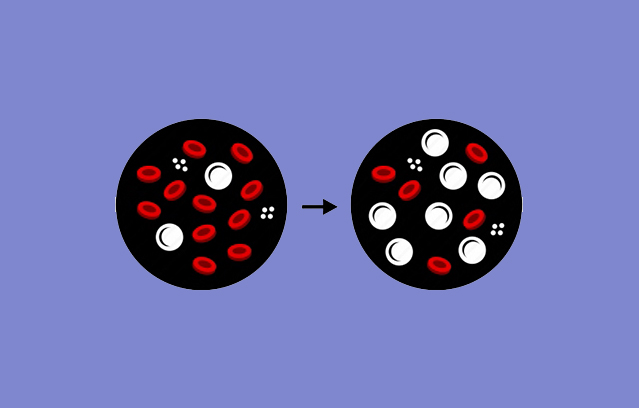
Leukaemia is the cancer of blood and blood originates from bone marrow. The most dreadful thing about leukaemia is that it has no cure. There are different types of leukaemia. The symptoms of which can be seen in weeks is called acute leukaemia. Chronic leukaemia as the words describe can be there in the body for a long time. The problem with leukaemia is that there is no early diagnosis. The only thing that can save us is the AGE! It can be cured if you are below your 20’s. This cancer affects all the age groups. The survival of young patients is better but not longer. The diagnosis is simple. Complete blood count and bone marrow aspiration can help to find leukaemia. The risk factors of this cancer are genetic mutations and environmental factors. Family history of leukaemia and smoking can also be a cause of cancer.
Leukaemia Cancer
Your body contains fluid and that fluid contains red blood cells, white blood cells and platelets. These cells are formed in the spongy centre of the bone called bone marrow. All the cells come from the parent cell called the stem cells. Red blood cells carry oxygen to the body tissue whereas white blood cells fight infection and help in maintaining immunity. Leukaemia is the cancer that originates from the white cells that are forming. The stem cells form abnormal white blood cells which weaken your immune system. This lowers the amount of other formed elements like red blood cells and platelets. That’s the reason it is also called blood cancer.
What causes Leukaemia?
The exact cause of leukaemia is still not known. There are general assumptions made by the scientists that the cause could revolve around genetic mutations and environmental factors. DNA is the backbone of the information. All the actions whether catabolism or anabolism are directed by DNA. The matter of fact is any change or mutation in this can lead to abnormalities. It is believed that there is a change in the structure of DNA of blood cells which results in abnormal growth. When the growth of the blood cells is out of control this results in fewer red blood cells, white blood cells and platelets. They attack the healthy cells of the bone marrow.
There are several risk factors that are associated with increased chances of leukaemia.
This includes previous history of cancer as people who have undergone treatment of cancer and have previous exposure to chemotherapy and radiation, they can easily have another cancerous growth.
Genetic disorders such as down syndrome have an increased risk of leukaemia.
There are certain chemicals like benzene or other chemicals which can induce cancer or can initiate certain cancerous growth. This is called cancer due to exposure to chemicals.
Smoking contains many carcinogens. People who smoke are more prone to cancer and thus might develop leukaemia.
Family history plays a key role in every cancer. Leukaemia is another such type where anyone in the family if ever was diagnosed with this cancer, you are equally prone to it.
Drug induced leukaemia is another type. Alkylating agents like nitrogen mustard, chlorambucil.
Acquired disorders like aplastic anaemia may transform into acute leukaemia.
Types of Leukaemia and their symptoms
The patient generally comes with symptoms like fever, weight loss and loss of appetite. The other symptoms include blood spot on the body, passage of bloody urine and stools. The other includes tiredness. It is broadly classified as acute and chronic. The classification is based on the maturity of the cells that are produced in the bone marrow. Acute leukaemia grows faster than you can imagine! It might take just weeks to spread throughout the body. The patient starts suffering from fever, significant weight loss, blood spot etc. Chronic leukaemia grows very slowly. The patient might not show symptoms for years. Your cancer specialist may find it tough to diagnose this condition. In acute leukaemia the blood cells divide rapidly and are arrested at an immature stage. These cells cannot move any further thus starts dividing rapidly. In fact acute leukaemia cells are in the first stage of development and thus show symptoms faster than chronic conditions. On the other hand, chronic cells multiply slowly and stay for a longer time. They are not present in their first stage of development.
Acute leukaemia is further divided into two types acute myeloid and lymphoid leukaemia. Normal myeloid cells can grow into red blood cells, granulocytes etc. But since in case of leukaemia they fail to differentiate this leads to accumulation of the blast cells in bone marrow leading to acute myeloid leukaemia. We have to look for certain markers in both the cells. The marker for myeloid blast is myeloid peroxidase enzyme. The cytoplasmic staining and auer rods can help the oncologist to find myeloid blast.
Acute lymphoblastic leukaemia is a group of neoplasm consisting of lymphoblasts. The major reason is chromosomal abnormalities. Hyperploidy and hypoploidy both could be the reasons. The structural abnormalities are caused by balanced chromosomal translocations. The common symptoms are almost similar to AML like bone marrow failure, extramedullary infiltrations and CNS involvement.
Chronic leukaemia is found in adults mostly. This also is divided into two major parts CML and CLL. The main symptom of CML is splenomegaly and leukocytosis. It is also defined as pluripotent hematopoietic stem cells. CLL is a tumour composed of monomorphic small B lymphocytes in the peripheral blood, bone marrow and lymphoid organs.
Leukaemia Diagnosis
Leukaemia is the cancer of blood cells. This mainly affects the amount of blood cells. So the best test considered is the blood test. The patient will come to an oncologist with a history of tiredness and weight loss. The skin of the patient will look a little paler. An oncologist might notice bruises all around your body. The patient might tell about bone pain as well. This will give your oncologist an idea about cancer conditions. This is helpful in making 60-70 % of the diagnosis. Later the full body examination is done to confirm the diagnosis.
Here is a list of tests that a cancer specialist will suggest:
Complete blood Count : This stands for complete blood count. It’s a really cheap and easy test to get. But tells a lot of information about red blood count, platelet, haemoglobin and haematocrit. Moreover it tells about WBC count as well. This can give an idea about the cellular condition of the blood. In leukaemia patients there will be a decrease in the red blood cells as well as mature white blood cells. There is shortage of all the cells and thus this accounts for the symptoms that the patient will come with.
Bone marrow aspiration is the test to answer that either the bone is not producing enough cells or these cells are being destroyed after the release. So the needle is inserted in the bone marrow and the fluid collected is placed on a microscope. This shows immature lymphoblasts which are tightly packed. There is no space left in bone marrow. This condition is known as hypercellular bone marrow. Is it normal to find immature cells? It’s definitely a yes! Bone marrow is the production house for blood cells. The percentage is just 20. So if a radiologist sees more than 20% of blast cells, then it’s leukaemia.
These are two most important tests that are done to confirm leukaemia.